The Exit Strategy
She almost didn’t go. At 3:17 p.m., her body staged a silent coup. It wasn’t a shout; it was a tightening, a slow-turn of the vice in her chest. It was that low-frequency hum in her nervous system—the sound of a refrigerator running in the dark, vibrating through the floorboards of her life.
But the chorus of the “well-meaning” reached a fever pitch. “You just need to be around people.” “It’ll be good for you.” “You can’t isolate forever.”
So, she performed the ritual. She stood before the mirror until her reflection felt like a stranger. She painted on a face that could survive the interrogation of fluorescent lights and the jagged edges of loud laughter. She practiced the “I’m fine” tilt of the head.
The version of her that could be consumed.
The Breach
When she walked in, the music didn’t just play; it hit. A physical wall of bass and heat. Then the cloy of expensive perfume and cheap gin.
Before her brain could even formulate a greeting, her nervous system had already mapped the battlefield:
- Door.
- Windows.
- Exits.
- The loudest voice.
- The heaviest drinker.
- The eyes that lingered a second too long.
Her body wasn’t at a party; it was on a reconnaissance mission.
She smiled through the static. Someone hugged her until it felt like a cage. Someone asked why she’d been “mysterious” lately—a polite word for absent. She laughed on cue, a perfect, hollow sound.
Inside, she was drifting. She was hovering three inches above the crown of her own head, a ghost narrating a scene she no longer wanted to haunt.
The Shift
The “Old Her” was an endurance athlete. She would have swallowed the dry mouth. She would have worn those shoulders like earrings, pinned up to her jaw in a permanent shrug of defense. Old Her believed that belonging was something you earned by overriding your own alarm system.
But thirty-seven minutes in, the air turned to lead. Nothing happened. No glass broke. No one screamed. It was just the cumulative weight of a thousand micro-calculations.
And for the first time in her life, she didn’t gaslight the girl inside. She didn’t whisper “Don’t be weird” or “You’re ruining the vibe.”
She looked at the overwhelm, and she gave it a seat at the table.
“I am done here,” she told herself. Not as a failure. As a fact.
The Mercy of the Cold
She didn’t announce it. No grand oratory, no “Irish exit” shame. Just a coat grabbed from a pile and a settled, “Good seeing you.”
The comments followed her like exhaust: “Already?” “This is why we can’t get you out!”
She didn’t flinch. She stepped onto the sidewalk and the cold air hit her face like mercy. It was sharp, clean, and honest.
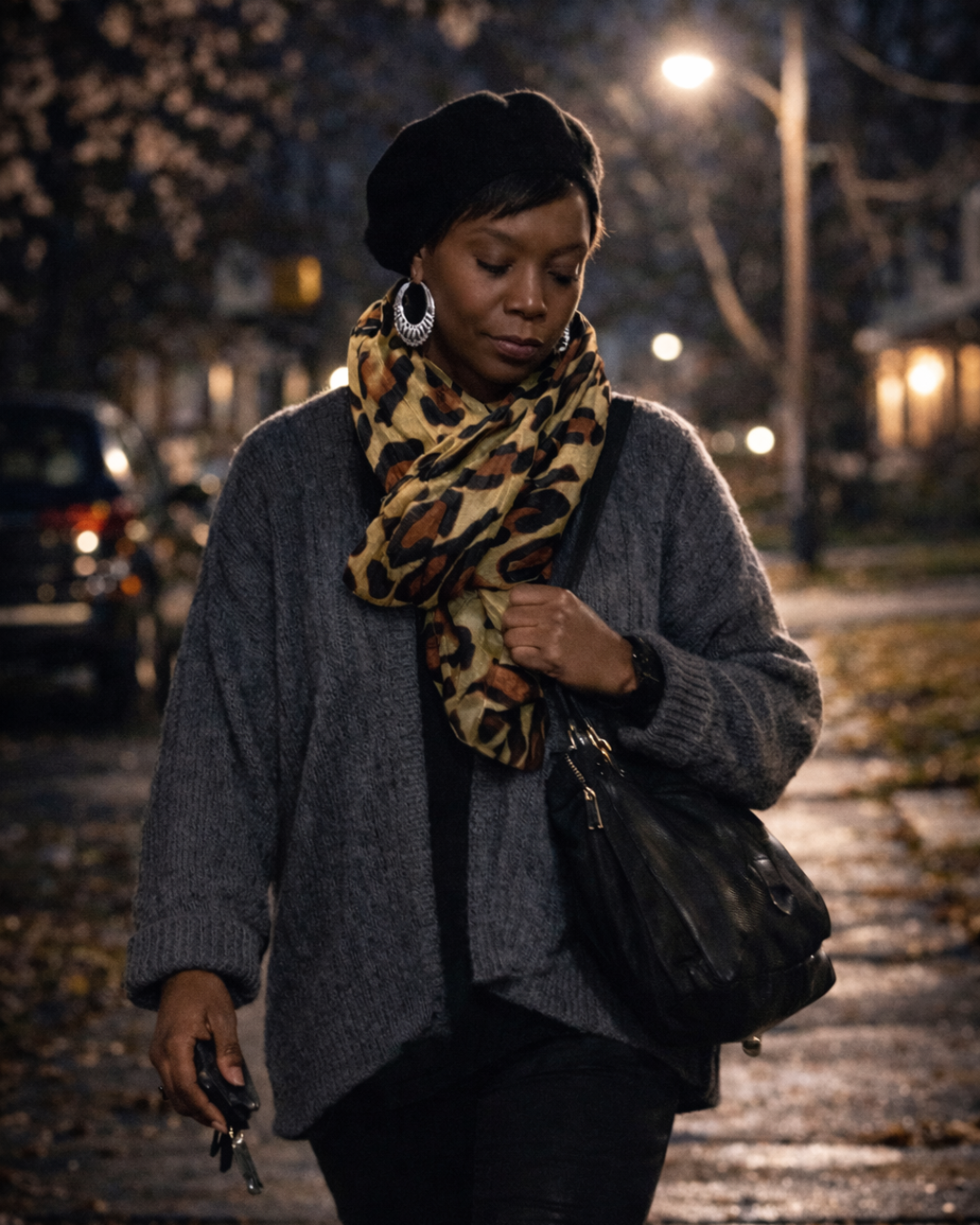
The walk home was a reclamation. The streetlights weren’t spotlights; they were guideposts. Every step was a refusal to abandon the woman she had just rescued. Her breath finally caught up to her body.
The win wasn’t surviving the room. The win was leaving it.
The Aftermath
Back at the apartment, the silence was a cathedral. She stripped off the costume. She washed the “normalcy” off her face. She didn’t eat what looked good on a social media feed; she ate what tasted like comfort.
She sat cross-legged on the couch, and for the first time in years, the refrigerator stopped humming.
She realized then: her hypervigilance wasn’t a defect. It was a memory. It was the five-year-old girl listening for footsteps in a hallway that never felt safe. Her body wasn’t “broken”—it was a loyal soldier still guarding a war that ended a decade ago.
Healing isn’t forcing yourself to endure the battlefield. Healing is realizing you’re allowed to walk off the field.
The Quiet Power
She used to measure growth by how much she could tolerate. Now, she measures it by how quickly she listens.
- Can I choose quiet over approval?
- Can I disappoint the room to save my soul?
- Can I be the “difficult one” and still sleep at night?
Tonight, the answer was a resounding yes.
No one chased her. No one revoked her humanity. The world didn’t end because she chose her own peace over their “good time.”
She turned on the soft lights—the ones that didn’t demand a mask. She let the silence hold her. And she realized the most rebellious truth of all:
She didn’t have to earn her seat in the quiet.
The party wasn’t the test. Self-trust was. And she passed—not because she stayed until the lights came up, but because she had the courage to turn them off herself.
Sometimes the bravest thing you can do is go home. And mean it.
Leave a Reply